f

The New Frontier of Memecoins

Memecoins have always been about attention. A meme catches fire, a community forms, liquidity follows, and suddenly an internet joke becomes a market.

But the next generation of memecoins may be about more than the meme itself.

Across Solana and Robinhood Chain, a new model is emerging: tokens that still trade normally against assets like SOL or ETH, while introducing rewards linked to other assets — from crypto to tokenized stocks.

The meme remains the attention layer. The reward mechanism creates another reason to participate.

From Meme to Thesis

This evolution fits perfectly with the growing FOMO culture around onchain trading.

Platforms like fomo.family are making trading increasingly social, with the concept of a “thesis” becoming part of the experience. Instead of simply buying a token, traders can explain why they are buying it — what they see, what they believe could happen, and what makes the opportunity interesting.

That changes the conversation from:

“This meme is pumping.”

to:

“Here is the thesis behind this meme.”

And that distinction matters.

The next generation of traders won’t just be looking at charts. They’ll be looking at the narrative, community, liquidity, launch mechanics, and increasingly, what the token actually does for its holders.

Where Stonk.fun Fits

This is where Stonk.fun becomes particularly interesting.

The token can still trade against SOL, but its ecosystem can introduce rewards in another asset. That could be another cryptocurrency, a tokenized stock, or another supported asset.

The meme doesn’t become the stock.

Instead, the meme becomes part of a reward economy.

It creates a new design space where:

Meme → Community → Trading Activity → Rewards → Asset Exposure

That is a significant evolution from the original “buy the meme and hope it goes up” model.

Where DeFiX Fits

This is exactly the market DeFiX loves to explore.

Our philosophy is simple:

Don’t just watch the meme. Understand the thesis.

That’s also why we’ve built the DeFiX Free Signals Group.

We monitor memecoins across multiple chains and look for interesting launches as early as possible. We analyze the narrative, early activity, liquidity, community, and mechanics — then share the tokens that catch our attention with the community.

No waiting until a meme is already everywhere.

The goal is to discover interesting opportunities as close to launch as possible, while giving members the information and thesis behind why we’re watching them.

Because the future of memecoins may not simply be about finding the next meme.

It may be about finding the next meme with a mechanism.

The meme creates the attention.

The thesis creates the conviction.

The mechanism creates the opportunity.

And the reward creates the loop.

Welcome to the next frontier of memecoins.

astranau-with-an-asteroid-with-eth-logo-3803547103

The Art of the Entry: Is it Still Possible to Win in the Sniping Game? 🌌

The $200M Asteroid Play: Are You Sniping or Just Donating? ☄️

If you watched ASTEROID on ETH teleport from a $50k micro-cap to a $200M monster while sitting on your hands, it’s time for a reality check. That 1 ETH to $470k wallet didn’t happen because of “luck” or manual clicking—it happened because someone had the right tech to filter the noise and strike.

The trenches are absolute chaos right now, but the Asteroid run proves the dream is alive. You just need to stop playing like a tourist. 🎒


No More “Rug” Roulette 🎰

Most traders think sniping is just “buying fast.” Wrong. If you’re just buying fast, you’re just the fastest person to get rugged. The secret sauce isn’t just speed; it’s the filters.

When a new meme hits the chain, you’ve got a split second to know if it’s a goldmine or a black hole. We’re talking:

  • 0.7ms Execution: Filtering out the garbage before the rest of the world even sees the contract.
  • The 11-Filter Gauntlet: Dev check, liquidity lock, and the big one—Bundle Checks. 🚫📦
  • Anti-Bundle Logic: If a dev bundles 40% of the supply in block 0, you aren’t “early”—you’re exit liquidity. Our tech ignores the bundled trash and leaves you with the actual, organic memes that have the legs to pull an Asteroid-level run.

The “First in Block” Advantage ⚡

On Solana or ETH, the goal is simple: Positioning. With a tool like DeFiX Sniper Ultimate, you’re fighting for that Block 0/Slot 1 spot. When you’re first in the block on a non-bundled launch, the risk profile flips. Even if the token doesn’t moon immediately, being first means you aren’t chasing green candles. It becomes a zero-sum game where you have the ultimate high ground. 🛡️

Stay Early, Stay Degen 🥂

Asteroid was a reminder that one good play can erase a year of bad ones. But to catch the next 4,000x, you can’t be fighting the UI or worrying about honey pots. You need to automate the boring stuff (the checks and filters) so you can stay focused on the moon missions.

Stop being the exit liquidity for the bots. It’s time to start being the one who snipes the bottom.

Polymarket-1522624935

Polymarket Copy-Trading Bots: How Smart-Money Mirroring Is Changing Prediction Markets in 2025**

Polymarket Copy-Trading Bots Are Taking Over — Here’s Why Everyone’s Talking About Them

Prediction markets exploded in 2024–2025, and Polymarket quickly became the go-to platform for betting on real-world outcomes. But as liquidity grew and sharp bettors started treating prediction markets like quant desks, a new kind of automation emerged: Polymarket copy-trading bots.

These bots let users mirror winning wallets automatically — turning the prediction market meta into something closer to follow-the-smart-money investing. For new traders, busy traders, and people who want exposure without doing hours of research, this has become a game-changer.

What Exactly Is a Polymarket Copy-Trading Bot?

A Polymarket copy-trading bot is an automation tool that tracks high-performance wallets on Polymarket. When a top bettor places a new position or adjusts an existing one, the bot instantly places the same trade in your wallet — following your own risk and sizing settings.

Think:

Smart-money alerts

Auto-execution

Risk-adjusted mirroring

No research required

24/7 market coverage

It takes the “who should I trust?” question out of prediction markets and replaces it with:
“Just copy the people who already win consistently.”

How These Bots Identify Top Wallets

Not all bettors are equal — and the good bots know that. Most copy-trading systems analyze stats like:

  • Long-term win rate
  • Expected value per position
  • Average return per market
  • Trade timing (early vs late entry)
  • Specialties like politics, macro, sports, or crypto events
  • Capital efficiency — how often they size positions correctly

The bot doesn’t copy random gamblers.
It copies consistent, data-driven operators.

This is crucial because prediction markets reward informed traders, not degens pressing buttons at 3 a.m.

Why Polymarket Copy Trading Is Exploding in 2025

Three big reasons:

✔ 1. Prediction market outcomes are complex

Election odds, CPI forecasts, geopolitical tensions — these aren’t meme tokens. Smart wallets often follow research, polling, insider sentiment, or niche statistics. Copying that research for free? Huge advantage.

✔ 2. Bots execute instantly

A human sees a smart wallet enter a market.
A bot enters within seconds.

Speed matters when probabilities shift fast.

✔ 3. It democratizes access

New users no longer feel “too dumb” to participate.
They copy experts, learn from trades, and gain confidence.

Who Should Use These Bots?

New Polymarket users who don’t know how to analyze probabilities

Busy traders who want passive exposure

Researchers & analysts who want to reverse-engineer smart-money behavior

Crypto users looking for exposure to non-crypto events (elections, sports, macro)

If you’ve ever wished you could “shadow trade” a sharp bettor — now you can.

Risks to Consider

No strategy is perfect, even if the wallets are.
Watch out for:

Performance variance — even elite wallets have drawdowns

Smart wallets front-running the bot (rare but possible)

Liquidity changes in small niche markets

Bot misconfiguration (sizing too large or too small)

Copy-trading bots don’t remove risk — but they shift you toward statistically better decision making.

Final Thoughts

Prediction markets are becoming data-driven ecosystems, and Polymarket copy-trading bots are the perfect bridge between beginners and pros. If you want hands-off exposure, smart-money mirroring is one of the most efficient ways to profit from market mispricing in 2025.

The future is automated — and prediction markets are the next frontier.

GoodInvestmentNew

Is Solana a Good Investment? Expert Insights & Market Trends

Introduction

Solana has stayed at the leading edge of blockchain networks that have competed with Ethereum because of their low fees and high-speed transactions. With upcoming upgrades, institutional interest, and expanding adoption, investors evaluate SOL’s potential as a good buy or another volatile asset.

This guide is a complete Solana review that goes through its fundamentals, outlook, and investing possibilities. Whether or not you’re on the hunt for a SOL prediction, price prediction, or how to make the most of investing in Solana, this post summarizes it all.

Solana Overview

What is Solana?

Solana is an affordable blockchain designed for decentralized finance (DeFi), smart contracts, and dApps. It processes high-speed transactions at low cost using a unique Proof of History (PoH) and Proof of Stake (PoS) hybrid consensus model.

Many investors researching Solana look for SOL price predictions to establish its long-term outlook. With its fast transactions and expanding ecosystem, it is one of the most desirable investments within cryptocurrency.

What is Solana?

    • Scalability: Handles 65,000 TPS, far ahead of Ethereum’s 15-30 TPS.

    • Lower Fees: Gas fees remain significantly lower than Ethereum’s.

    • Enterprise Adoption: Companies like Franklin Templeton are integrating Solana-based financial applications.

What is Solana?

    • NFT Marketplaces – Platforms like Magic Eden leverage Solana’s cost efficiency.

    • DeFi Protocols – Exchanges like Jupiter and Orca use Solana’s fast processing.

    • Enterprise Solutions – Businesses are integrating Solana for Web3 and financial applications.

Solana’s Current Fundamentals

As of February of 2025, market estimates have Solana investments well over $94 billion, making it sixth-largest after Bitcoin, Ethereum, Binance Coin, and XRP but clear of Avalanche and Polkadot. With very positive investor sentiment and continuing onboarding by institutions, folks are asking, “Is Solana a good investment?” Market commentators believe continuing growth within DeFi, NFTs, and business use drives its fate.

Key Strengths

    • 65,000 TPS Speed: One of the fastest blockchains today.

    • Low Fees: Ideal for high-frequency trading and DeFi applications.

    • Scalability Without Layer 2: Unlike Ethereum, Solana scales natively.

    • Firedancer Upgrade (2025): Expected to enhance speed and stability while reducing congestion issues.

Challenges

    • Decentralization Concerns: Only 2,000 active validators vs. Ethereum’s 800,000+.

    • Network Stability: Past outages have affected its reliability.

    • Ongoing Improvements: Developers continue enhancing network decentralization.

Is Solana a Good Investment for the Long Term?

According to a recent investment analysis, Solana’s ecosystem has over 10 million active addresses, with strong growth in NFTs and DeFi. Institutional investors continue to fund Solana-based projects, with $173 million allocated in Q3 2024, a 54% increase from the previous quarter.

Adoption Growth

    • NFT Marketplaces: Magic Eden and others prefer Solana for low fees.

    • DeFi Protocols: Jupiter and Orca leverage their fast transactions.

    • Enterprise Use Cases: More companies are integrating Solana-based apps.

Additionally, 8,000+ developers joined Solana in 2024, the highest of any blockchain, driving innovation across gaming, DeFi, and enterprise applications.

Solana’s Ongoing Developments and Future Potential

Based on technical analysis, Solana is gearing up for major upgrades and ecosystem expansions in 2025, enhancing speed, stability, and institutional adoption.

    • Firedancer Upgrade (2025): Aims to increase transaction speed and reduce network congestion.

    • Solana Seeker (Web3 Mobile Device): Expands Solana’s use beyond DeFi and NFTs into consumer applications.

    • ETF Approvals & Institutional Investment: Potential Solana ETFs could boost liquidity and price stability.

    • Sol Prediction & Market Outlook: Analysts forecast Solana’s long-term value growth, with price predictions suggesting SOL could reach $250-$500 by 2026, depending on adoption rates, regulatory clarity, and institutional demand.

Risks and Rewards of Investing in Solana

Solana offers fast transactions, low costs, and good adoption but also has challenges that can make its long-run success uncertain. The following is what investors need to know before making a decision.

Rewards

    • Fast Transactions And Low Fees: Solana is capable of handling 65,000 TPS very cheaply, making it scalable and appropriate for frequent trading.

    • Growing Adoption: Enterprise blockchain solutions, DeFi protocols like Jupiter and Orca, and NFTs continue to expand within the Solana ecosystem.

    • Strong Developer Network: 8,000+ developers onboarded throughout 2024, making Solana one of the most developed blockchain

Risks

    • Network Stability Issues: Solana has seen frequent outages due to congestion and validator crashes that have disrupted trading and use of DeFi. While Firedancer upgrade (2025) is likely to make it more reliable, past breakdowns caution against using it for mission-critical use cases.

    • Regulatory Uncertainty: While ETF listings can attract institutions to invest, uncertain rules and potential securities classification issues can curb Solana’s growth.

    • Centralization Concerns: With only 2,000 validators compared to Ethereum’s +800,000 validators, Solana’s network security and governance are called into question. A lower validator pool increases the stakes of centralized control and manipulation.

    • Competition from Rival Blockchains: Solana is pitted against Ethereum, Avalanche, and Polkadot, each of which has attractive alternatives to DeFi, NFTs, and corporate onboarding. Continual innovation is critical to maintaining market share.

    • Institutional Sell-Off Risk: The FTX collapse of 2022 also showed that Solana is vulnerable to large institutional sell-offs. A large liquidation of SOL can lead to transient price movements, influencing investor sentiment.

CryptoDayNew

Crypto Day Trading Strategies: Profitable Tips & Best Practices

Exploring crypto trading strategies? Then, you’re probably already familiar with the concept of “crypto day trading”. The dynamic nature of cryptocurrencies, and their potential to deliver incredible profits, has prompted numerous investors to pick crypto for day trading opportunities. 

In 2025, in December 2024, the 24-hour BTC trading volume reached a value of over $146 billion. But crypto day trading isn’t for everyone. The market is volatile, unpredictable, and often tricky for beginners to navigate.Successful traders can’t just rely on luck. They employ time-teste strategies – mixing strong market research with quick decision-making, and a careful approach to risk management

If you want to replicate their results, you need a plan. Solutions like HyperLiquid AMM Bot from DeFiiX can offer investors the tools to make trades more efficient, data-driven, and effective. But, even with the right tools, you still need a roadmap for success. 

What is Crypto Day Trading?

Before you can start day trading cryptocurrency, you need to know what “crypto day trading” actually is. Essentially, day trading cryptocurrency is the practice of buying and selling cryptocurrencies in a single day, to capitalize on short-term price movements.

Unlike traditional markets, cryptocurrency markets run 24/7, giving traders a constant stream of opportunities. Plus, there’s volatility and liquidity to consider. While volatility might sound like a bad thing – it’s great for day traders who need to take advantage of sudden changes. 

High liquidity means that investors can execute orders fast. Traders often flock to currencies like Bitcoin (BTC) and Ethereum, because both have exceptional volume, allowing traders to leverage big positions without slippage.Decentralized Exchanges (DEXs) like Uniswap and Raydium also boost accessibility for traders, allowing users to trade tokens directly from a digital wallet, without middlemen. This boosts flexibility, and agility for traders, but it does come with some risks too. Hype events (like the TRUMP memecoin surge in January 2025) can cause sudden changes in market environments.

Sometimes these changes are positive, and sometimes they cause headaches for quick-moving day trading fans. That’s why the right day trading cryptocurrency strategy makes all the difference. 

Best Crypto Day Trading Strategies

As of February of 2025, market estimates have Solana investments well over $94 billion, , making it sixth-largest after Bitcoin, Ethereum, Binance Coin, and XRP but clear of Avalanche and Polkadot. With very positive investor sentiment and continuing onboarding by institutions, folks are asking, “Is Solana a good investment?” Market commentators believe continuing growth within DeFi, NFChoosing the best day trading cryptocurrency trading strategies isn’t easy. No strategy is guaranteed to be profitable for every trader. Often, the best traders need to invest significant time and effort into experimenting with different methods to ensure the right results. 

Still, there are some common crypto trading strategy options that appeal to beginners and seasoned traders alike, such as: Ts, and business use drives its fate.

Momentum Trading

Momentum trading is all about riding powerful waves in the cryptocurrency market. You look for assets showing strong upward or downward momentum, hop on board, then exit before the opportunity fizzles out. Beginners and pro traders using momentum trading often rely on two key indicators to help guide their strategy:

    • RSI: The relative strength index (RSI) helps traders spot overbought or oversold conditions, offering tips on when momentum might be winding down. If a cryptocurrency rockets too high too fast, the RSI often signals it’s time to get out.

    • Moving Averages: Many traders keep their eyes peeled for golden crosses (when a short MA crosses above a long MA) and death crosses (the opposite). During Bitcoin’s 2025 surge, some traders who spotted a golden cross early bagged quick gains.

Momentum trading in cryptocurrency requires a lot of technical analysis and research, but it’s also one of the best strategies you can execute for profitable outcomes – when done correctly.

Range Trading

Another popular option among traders looking for the best crypto trading strategy is range trading. When the market isn’t exploding up or down, it can bounce between predictable support and resistance levels. That’s where range trading stands out. 

Beginners and experienced traders examine the “support level” (when an asset tends to stop falling in price) and the resistance level (when an asset’s price stops rising) to make trade decisions. As an example, in 2025, Ethereum maintained a lot of resilience with a $2,700 support level, introducing a great opportunity for range trading in the crypto market.

Arbitrage Day Trading

Automation and AI are becoming the best tools for any beginner, or pro trader in the cryptocurrency market. You don’t need extensive know-how or experience to leverage these tools for great wins. Bots run predefined rules, scanning for patterns and placing orders without emotion.

They run 24/7, execute trades without emotion, and help you make the most out of your trading strategy. Innovative bots and automation tools can also help developers and founders improve the appeal and liquidity of their tokens.


Trading Bots & AI Trading

If you’re quick about making decisions, arbitrage trading could be the best option for you. It’s all about buying an asset when it’s cheaper, and selling it where it’s more expensive (on a different exchange with different pricing).

For example, if Ethereum is priced at $1,800 on Exchange A and $1,820 on Exchange B, an arbitrageur could buy on Exchange A and sell on Exchange B for a profit, minus transaction fees. This day trading strategy is valuable for cryptocurrency investors, but it’s tricky too – as you have to act fast to avoid extra fees and slippage. Beginners might struggle here.

How to Pick the Best Cryptos for Day Trading

Part of developing the best crypto day trading strategy, is figuring out which crypto you should trade. Ultimately, there’s no one-size-fits-all option. The most important things for the top traders and beginners to focus on include:

    • High liquidity and trading volume: If you can’t easily get in or out of a trade, you risk slippage or partial fills. Look for tokens with robust 24-hour volume – billions of dollars traded daily. Bitcoin and Ethereum are the classic options, but hot altcoins occasionally spike in volume during hype cycles.

    • Volatility and price action: Beginners often fear big price swings, but day trading thrives on volatility. The best approach is to know your risk appetite. High-volatility coins like Solana or Avalanche can yield big intraday moves. If you see repeated 5–10% shifts in a single day, you know there’s a great opportunity there.

    • Market sentiment and news impact: Social media buzz can skyrocket a low-cap token or crush a leader overnight. Tweets from influencers or headlines about regulatory crackdowns may send prices off a cliff. Stay glued to platforms like Twitter, Reddit, or CoinTelegraph for the latest chatter.

If you’re looking for extra tips to guide you, remember to diversify (don’t go all-in on one token), particularly if you’re a beginner. Use AI and automation tools to guide you, and always update your research with the latest news and insights from different exchanges.

Also, remember, tokens associated with credible projects, strong developer activity and supportive communities are often your best bet. 

Best Cryptos for Day Trading

If you’re still unsure about the best cryptocurrency for day trading, here are some reliable heavyweight options for beginners:

    • Bitcoin (BTC): The champion of crypto, Bitcoin benefits from enormous liquidity and massive daily volumes, enabling fast entries and exits. Bitcoin also experiences strong intraday price swings, giving traders plenty of chances to dive in.

    • Ethereum (ETH): As the leading smart contract platform, Ethereum’s popularity fuels robust price action. It powers everything from DeFi to NFTs, so news and upgrades often trigger dramatic intraday moves, great for day trading.

    • Binance Coin (BNB): Linked to the Binance ecosystem, BNB benefits from a lot of trading activity and has a dedicated user base. Fee discounts add an extra incentive, and it’s often involved in top altcoin rallies.

    • Solana (SOL): Solana’s rapid transactions and low fees draw developers and traders in by the thousands.

    • Cardano (ADA): A strong dev community backs ADA, and its speculative swings make it attractive as one of the best day trading currencies. Frequent updates and community-driven projects often spark valuable price moves.

Pros and Cons of Crypto Day Trading

Crypto day trading can be thrilling, but it’s not a guaranteed ticket to riches. Here’s a quick guide to the upsides and downsides to keep in mind:

Pros:

    • High Profit Potential: Volatile cryptocurrency markets can deliver quick gains if you know where to enter and exit.

    • Profit in Bull or Bear Markets: You can go long or short, turning even a downturn into opportunity for growth.

    • 24/7 Trading Opportunities: Unlike traditional markets, crypto never closes. You can trade any time, day or night.

Cons:

    • High Volatility Risks: Wild price swings can wipe out your gains if you’re not proactive with stop-loss orders.

    • Requires Strong Technical Analysis Skills: You’ll need to master charts, indicators, and patterns to succeed constantly. 

    • Trading Fees & Potential Losses: Each trade costs money, and frequent transactions add up. Over time, fees can slice into your profits, and losses can mount if your “best” strategy doesn’t work as expected. 

Top Mistakes to Avoid in Cryptocurrency Day Trading

Even with the best “how to” guide for cryptocurrency day trading, beginners and top traders can still make mistakes. There’s more to success than just following the top market tips. Here are some of the key mistakes to avoid for beginners and seasoned traders:

    • Trading Based on Emotions and FOMO: Fear of missing out leads many traders to chase opportunities blindly. In 2025, a wave of meme coin mania lured beginners into sky-high entry points, only for tokens to crash days later. Create your best strategy based on technical insights and fundamental tips, rather than hype. 

    • Ignoring Risk Management Techniques: Skipping stop-loss orders and risk management tips is dangerous. A single unlucky trade can be disastrous, even for the top trader.  Always define how much you’re willing to lose before you press “buy.”

    • Over-Leveraging Without Stop-Loss Strategies:  Leverage is a double-edged sword. It’s easy to make mistakes and lose more money than you can afford to give away. If you’re going to be using leverage , keep it modest, and deploy stop-losses religiously. 

    • Not Using the Right Tools to Enhance Trading Success: Manual day trading without automation and AI just isn’t efficient. The best and top traders know the value of bringing technology into their trade strategy. Even token developers know that they can improve token liquidity and appeal with the right tools. 

How to Start Day Trading Crypto: Best Tips

If you’re a beginner in the cryptocurrency day trading space, getting started can sound complex. Even if you have an idea of the best strategy, or the top crypto coin to trade, and you’ve read guide after guide, you can get overwhelmed. Here our best tips for success.

Step 1: Choose the Best Exchange

Not all exchanges are the best for crypto day trading. Look for top cryptocurrency platforms that promise high security, excellent liquidity, and a great trading experience. For instance:

    • Binance: Huge coin selection and relatively low fees.

    • Coinbase: User-friendly, great for beginners, but fees can be higher.

    • Kraken: Trusted for security, offers margin trading for advanced traders.

Make sure the exchange is available in your region and supports the tokens you want to trade too.

Step 2: Build a Top Risk Management Plan

A common beginner mistake is to dive into crypto day trading without the best guardrails. Don’t all into this trap. Take a lesson from top traders and:

    • Define Your Risk Tolerance: Many of the best pros risk only 1–2% of their capital per trade. Be cautious about how much capital you risk. 

    • Use Stop-Loss Orders: Decide exactly when you’ll exit if the market turns. Use automation to exit trades automatically (leaving emotion out of the equation) 

    • Diversify: Don’t just hold one coin; spreading out can lessen the blow of a bad trade.

Step 3: Use the Best Tools

Tools can transform your day trading strategy, and save you a lot of time. Automated bots help you act on the best signals fast. Bots like our DeFiX Hyperliquid, on the other hand, makes it easy to boost liquidity and trading volume for tokens on Solana-based exchanges. It can:

    • Boosts Liquidity: Draws more traders into your pool, creating tighter spreads for better fills.

    • Enhances Volume: Perfect for short-term campaigns on DEXs like Raydium or Orca.

    • Works with Bots: Automate your day trading moves on your token and let our Bots maintain healthy market operations even when you’re sleeping.

Step 4: Test Strategies Before You Start

As a beginner, before you start committing real capital to anything, the best thing you can do is put your strategy to the test. Use paper trading platforms to simulate trades in real market conditions, and leverage back testing to apply your strategy to historical data.

After you’ve tested thoroughly, go live with small positions. Gradually ramp up as you gain confidence. Remember: even the best crypto trading strategy can falter in extreme conditions, so keep adapting and evolving. 

ilntddgbvc4ujb7vj44q

Solana EXTREMELY Bullish

ETF provider REX Financial and asset management firm Osprey Funds may be on the verge of launching the first staked Ethereum (ETH) and Solana (SOL) ETFs in the US, following a new development in their regulatory process.

According to Bloomberg ETF analyst Eric Balchunas, the SEC said in a June 27 statement that it had “no further comments” on the firms’ filings.Source: Eric Balchunas

The update came in response to a request submitted by REX and Osprey to the SEC, seeking confirmation that all staff comments on their staked Ethereum and Solana ETFs had been resolved.

REX and Osprey filed for staked SOL and ETH ETFs in late May, proposing ETF structures that would allow the funds to hold and stake the two prominent crypto assets and distribute stake rewards to shareholders.

However, the SEC immediately raised concerns that REX and Osprey’s proposed funds may not qualify as ETFs under existing rules due to their unique C-corporation business structure. The structure conflicts with the ETF rule, which defines acceptable corporate forms for ETFs.

Despite regulatory hurdles, industry professionals were hopeful for a resolution, allowing the funds to bring new liquidity into the crypto market.

“Here’s the SEC saying it has no further comments, so they are good to launch it looks like,” said Balchunas.

REX and Osprey have also signaled readiness from the product side. A newly released “Coming Soon” campaign prominently features the upcoming staked ETH and SOL ETFs on their website, though no official confirmation has been issued regarding approval or launch dates.

The SEC has signaled potential approval for Solana ETFs later this year, following a recent request to revise language around in-kind redemptions and staking practices, suggesting a growing openness to incorporating staking into ETF structures.

All seven asset managers seeking to launch Solana ETFs, including Grayscale, VanEck, 21Shares, Canary Capital, Bitwise, and Franklin Templeton, have updated their filings to include staking capabilities in response to the SEC’s feedback.

Why is Ethereum (ETH) price up today?

Key takeaways:

  • Ether is set for its best weekly gain since May 2021.
  • Ethereum’s Pectra upgrade, mega-whale accumulation, and a major short squeeze fuel the rally.
  • Technical patterns suggest a potential 40% rally toward $3,400 as ETH bounces off key support.

Ether ETHUSD is on course to record its best weekly performance since May 2021, having risen by over 37.50% in the week ending May 11, including 10.30% gains in the last 24 hours.

US tariff updates, Pectra upgrade boost Ethereum

The announcement of a new trade agreement between the US and the UK on May 8 and the initiation of US-China trade talks afterward have bolstered upside sentiment in Ether and the broader crypto market.

Additionally, Ether benefits from its Pectra upgrade on May 7, which introduced key improvements like higher staking limits and account abstraction (EIP-7702) to make Ethereum easier and more flexible.

These upgrades are helping ETH’s price rise faster than the broader crypto market. Since May 8, Ether has gained over 34.3%, outperforming the crypto market’s 10.91% increase in total capitalization during the same period. 

Bitcoin BTCUSD, despite breaking above the symbolic $100,000 mark, has also trailed Ethereum’s percentage gains.

Cryptocurrencies, Markets, Market Analysis, Ether Price, Ethereum Price

Ethereum short squeeze boosts ETH price

Short liquidations in the Ethereum Futures market have been fueling upward momentum further. 

Since May 8, traders betting against Ethereum have been forced to close their positions, with $437.94 million in short liquidations recorded. At the same time, $211.29 million in long liquidations have also occurred. 

As prices climbed, short sellers had to buy back ETH to cover their losses, pushing the price even higher.

At the same time, Ethereum’s open interest—the total value of outstanding futures contracts—has increased sharply from $21.28 billion on May 8 to $26.77 billion on May 10. 

Additionally, weekly funding rates for Ethereum perpetual futures rose from 0.10% to 0.15% during this period.

This rise in open interest shows more traders are entering the market and opening new positions. Higher funding rates indicate that more traders are going long (betting on higher prices) and are willing to pay extra fees to keep those positions open.

Both metrics signal bullish bias among Ethereum futures traders.

Ethereum rally precedes mega-whale accumulation

Ether’s price rally in the past days has preceded substantial accumulation among its “mega-whales,” i.e., wallets holding over 10,000 ETH. 

The Glassnode chart illustrates that mega-whale net position change has flipped positive since late April, with whales steadily increasing their ETH holdings.

Cryptocurrencies, Markets, Market Analysis, Ether Price, Ethereum Price

At the same time, the total supply held by these large entities has risen to its highest level since March 2025, surpassing 40.75 million ETH.

This accumulation suggests that large investors are positioning for further price gains, boosting upside confidence across the Ethereum market.

Cryptocurrencies, Markets, Market Analysis, Ether Price, Ethereum Price

Ether’s key support bounce hints at $3,400

Ethereum’s price is bouncing off a long-term ascending support line visible on the monthly chart, forming the lower boundary of a large symmetrical triangle pattern.

Cryptocurrencies, Markets, Market Analysis, Ether Price, Ethereum Price

This bounce increases the likelihood of a move toward the triangle’s upper trendline near $3,400 in the coming months, up by around 40% from the current price levels.

Historically, ETH has seen strong rallies each time it touches this support, reinforcing the bullish outlook, which echoes Peter Brandt’s analysis that predicts ETH price to “moonshot” toward similar targets.

This article does not contain investment advice or recommendations. Every investment and trading move involves risk, and readers should conduct their own research when making a decision.

Cover-12-800x365

What Is NFT Sniping?

9 min

Recently, the NFT sphere has become a real magnet, attracting an incredible number of investors interested in making money on digital objects. In the background of the excitement around the new opportunities that NFT projects provide, many different practices allow you to monitor the NFT market and promptly buy the necessary lots. One such practice is NFT sniping.

This article will help you understand what NFT snipping is and where it came from. You will also learn about what techniques and tools are used for this practice and what impact it has on the NFT space.

  1. NFT sniping is a new practice that allows you to analyse NFT markets in order to quickly buy undervalued NFT projects at a favourable price.
  2. NFT sniping uses different methods to detect potentially lucrative NFT projects, the most effective of which are sniping bots.

NFT sniping is a recently widespread practice based on analysing the market and searching for new or undervalued NFTs of projects whose actual value differs from the real value for a number of reasons in order to buy them quickly before other interested parties do so. In other words, NFT sniping is a tactic of instant purchase of NFT projects on the market at the most favourable price for further trading or resale at a higher price, while the real value is unknown to the general public. The advantage of this approach is that NFTs in high demand or undervalued are bought at the most favourable price at the time of project launch, which does not allow other bidders to raise the rate to repurchase it and creates the potential for a significant profit.

The expression NFT sniping describes a military term implying shooting at the enemy from cover, with high accuracy and at long range. This practice was the result of the development of the NFT niche, which by its nature is a dynamically changing environment, where in some cases, the sale of NFT projects is a kind of auction, giving the opportunity to purchase the necessary token at the most favourable price (floor price) using highly accurate and fast tools of analysis and monitoring of different marketplaces and sites involved in their implementation. In this case, NFT sniping emphasises the speed and efficiency of operations aimed at acquiring NFT and its subsequent resale.

Today, with some programming knowledge, you can create your own sniping bots to analyse NFT markets and projects.

Despite the fact that NFT sniping is a relatively new practice of generating increased profits from the sale of niche projects, it has a rampant popularity that has come due to the practicality of the method based on the use of highly effective tools for finding undervalued NFTs. Among them, the following stand out:

NFT snipers have been shown to join a variety of online communities and groups where they can find like-minded individuals and exchange information, tips and ideas related to new and valuable NFT project listings. For this purpose, any popular information resources, social networks like Facebook or messengers, including NFT sites and various forums are used.

As it enables them to share expertise and keep up with market trends and possibilities, information sharing among such groups can be a useful tool for NFT snipers. Collaboration and information exchange also assist snipers in enhancing their tactics, finding new analytical instruments, and navigating the challenges of the NFT market. To avoid potential fraud or inaccurate information, caution must be exercised while disseminating information, and the credibility of sources must be confirmed.

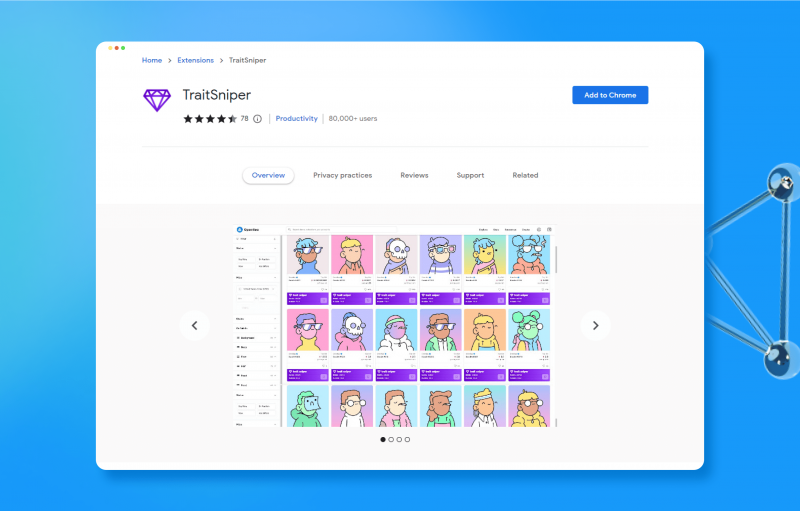
Another group of tools that give rarity snipers an advantage in the NFT market when buying projects are browser permissions. They are programs and services that work on the model of a search engine that helps to track different marketplaces and platforms trading NFTs, analyse their lists and send notifications in case of new or undervalued NFTs in the public domain. Browser extensions can also provide useful analytics and information about the NFT market, such as pricing trends, historical data, and rarity analysis.

Thanks to the functionality of these extensions, it becomes possible not only to conduct a comprehensive assessment of each NFT project according to a variety of criteria, the most important of which is rarity, but to collect analytical and statistical data, including information about the origin of the project, its category, date of creation, as well as the blockchain network in which it was created.

One of the most popular tools playing a significant role in NFT sniping is sniper bots. NFT sniper bot is an automated system based on mathematical calculations that perform complex analysis and monitoring of the NFT market in real time in order to find undervalued and potentially profitable projects according to a number of criteria, such as value, NFT rarity, or price. The sniping bot program allows you to automatically buy NFT projects that meet the necessary purchase requirements, giving a great advantage in speed and efficiency over manual methods of carrying out the same process. Sniping bots are expected to evolve with the help of AI technology.

As the world of NFTs continues to expand, NFT sniping has become a divisive practice, receiving both support and criticism. In spite of the fact that many individuals perceive this to be a smart trading strategy, concerns have been raised regarding ethical considerations and the potential negative impact on the NFT market. A decision regarding how NFT sniping will be handled in the future will be based on the trajectory of the NFT market. Any regulatory measures or market adaptations to level the playing field will depend on the future trajectory of the NFT market.

To date, the impact of sniping practices on the NFT industry is the subject of active discussion in this area. Some experts argue that this hair dryer will contribute to market instability, which in turn will provoke the process of artificially inflating the cost of NFT projects, creating barriers for ordinary market participants who do not have much capital. On the other hand, many are of the opinion that this practice is based on a mechanism that determines an integral component of competition in markets where their participants are constantly looking for opportunities to profit.

Since this practice has been developed and has support among many NFT market participants due to its potential profitability, it is highly likely that in the foreseeable future, there will be systems and solutions preventing the possibility of getting access to potentially profitable projects in advance by analysing their data with the help of various programs. This position is conditioned by the need to ensure transparency and trust, as well as equal competition, giving every investor the opportunity to have a chance to buy an NFT project at the best price at the very last moment.

The practice of NFT sniping is based on the use of automated bots that help to quickly and efficiently analyse the markets of NFT projects and make profitable purchases. The NFT community conducts experiments studying the possibilities of this tactic for its operability, which in practice will allow getting high profitability results within the framework of buying undervalued NFTs.

6a3dfcf4686b4b2baf63a0fc9fdf0f50

Bitcoin Sniping Coming Soon? Ordinals Sniping

Ordinals, this year’s incarnation of NFTs on Bitcoin, have enjoyed a slight resurgence in recent weeks. A bubbly launch peaked on May 7 of this year and quickly subsided, but now Bitcoin’s rally in November has renewed interest in Ordinals.

Sniffing an opportunity for profit and prepared with months of practice since May, quant traders lurked. Their opportunity arrived this week at Magic Eden on Bitcoin, an NFT marketplace. They sniped millions.

The most highly anticipated Ordinals project of the season, Ordibots, had announced its minting ceremony on the most prestigious Ordinals exchange, Magic Eden. A timeline for its launch was widely publicized. Requirements for whitelisting were extensive. Ordibots’ community discussions were vibrant. The minting ceremony had a tantalizing countdown, with buyers setting alarms to attend – ready to inscribe their NFT on-time. Collectors anticipated the mark-to-market capitalization of the collection to reach untold millions of dollars. 

Ordibots, however, became the first major Ordinals collection to fall victim to a sophisticated front-running attack. Its founders, and the NFT marketplace Magic Eden, have apologized.

Here’s how it happened

Sniping Ordinals for profit

Whitelisted fans of Ordibots submitted their minting transactions to inscribe their Ordibots NFTs onto Bitcoin satoshis, the smallest denomination of one coin.

After they broadcast their Bitcoin transactions, however, they wait in Bitcoin’s mempools for around 10 minutes. Like any other Bitcoin transaction, they must wait for miners to select their transactions for inclusion in a valid block — and then mine that block, which usually takes 10 minutes.

All of that delay is plenty of time for a sophisticated quant trader to snipe their mint with a front-running attack.

Ordinals sniping is a front-running attack

Ordinals sniping involves scanning Bitcoin’s mempools for a valuable Ordinal transaction, like an Ordibots minting inscription, copying the transaction, changing the wallet address, and outbidding the transaction fee slightly. By default, mining pool operators will usually select a transaction with a higher transaction fee — rewarding the quant sniper, and leaving the whitelisted Ordibots fanboy with nothing but an unconfirmed transaction. 

Like all front-running attacks, Ordinals sniping steals valuable Ordinals NFTs for only the cost of surveillance and a slightly higher transaction fee.

The sniper can then quickly resell their stolen merchandise on an NFT marketplace for tidy profit. Although flipping Ordinals might be difficult for illiquid collections, snipers thought one of the biggest collections of the year was worth the trade.

Ordibots organizers apologize

Magic Eden on Bitcoin (the Bitcoin Ordinals division of the NFT marketplace that started on Solana) had even created a custom portal for the Ordibots minting ceremony. Unfortunately, neither Magic Eden’s portal nor Ordibots’ official website were able to protect users from the mempool snipers.

After the front-running attacks, Ordibots tweeted that it was trying to collect information on addresses affected by the attack. It apologized and promised to airdrop custom Ordibots to those addresses. Then, Ordibots said it would burn the Ordibots “parent” used to generate those NFTs in order to ensure immutability.

Obviously, many users complained about the experience. Some were confused for a while, not quickly aware of the front-running. Others figured out what happened pretty quickly.

One grateful fan complimented Ordibots’ quick response to the situation and said it would be cool to see a derivative collection of Ordibots images containing sniper rifles.

Magic Eden on Bitcoin also apologized to buyers who attempted to use its Launchpad to buy an Ordibot but failed due to the front-running. It says it is deploying a solution to mitigate future front-running attempts.

Front-running “sniping” attacks

Mempool sniping is a form of front-running. Front-running traders normally profit from privileged information, then outpacing their victims. For example, if they know that somebody placed a large trade order, they try to sneak their own order in before the victim’s order is executed. Front-running bots can execute the same strategies by detecting large transactions that might indicate a front-running profit opportunity.

If front-running or sniping sounds familiar, it is. Indeed, it is a form of MEV (maximum extractable value). It is also a common quant trading tactic in traditional finance.

Although developers have attempted to mitigate MEV, even Ethereum founder Vitalik Buterin admits that MEV will never end. All Turing-complete blockchains with on-chain assets suffer from MEV. 

In response to the Ordibots sniping attack, The Ordinals Show host Leonidus warned that the Ordinals community will have to “get much more sophisticated very quickly.” He added that the Ordibots situation could just be “the tip of the iceberg.”

Later, Leonidus clarified that snipers cannot steal existing Ordinals inscriptions. Front-running attacks only affect trades (not assets), such as mints or PSBT swaps.

In short, the quant trading tactics of traditional finance are now affecting Bitcoin. Ordinals sniping has occurred with on-chain Bitcoin assets, Ordinals. Ordibots became the first known collection to be targeted by mempool “sniping,” a sophisticated attack from the realm of quant trading.

935a00_eea70ee147314df0b6f7fe09e04c5e89~mv2

Uniswap V2: An Introduction to Automated Market Makers {Why frontrunning works}

Uniswap is a DeFi app that enables traders to swap one token for another in a trustless manner. It was one of the early automated market makers for trading (though not the first).

Automated market makers are an alternative to an order book, which the reader is assumed to already be familiar with.

How AMMs work

An automated market maker holds two tokens (token X and token Y) in the pool (a smart contract). It allows anyone to withdraw token X from the pool, but they must deposit an amount of token Y such that the ”total” of assets in the pool does not decrease, where we consider the “total” to be the product of the amounts of the two assets.

𝒳𝒴 ≤ 𝒳′𝒴′

Here 𝒳′ and 𝒴′ are the token balances of the pool after the trade and 𝒳 and 𝒴 token balances of the pool before the trade.

This guarantees that the pool’s asset holdings can only stay the same or increase.

Most pools enforce some kind of a fee. Not only should the product of the balances increase, but it should increase by at least a certain amount to account for a fee.

Assets are provided to the pool by liquidity providers, who receive so-called LP tokens to represent their share of the pool. Liquidity provider balances are tracked in a manner similar to how ERC 4626 works. The difference between an AMM and ERC 4626 is that ERC 4626 only supports one asset but an AMM has two tokens. Just like a vault, the liquidity providers’ share of the pool stays the same, but the product 𝒳𝒴 gets larger, so their slice is larger.

Advantages of AMMs

AMMs do not have a bid-ask spread

In an AMM, price discovery is automatic. It’s determined by the ratio of assets in the pool. Specifically, if we have token 𝒳 and token 𝒴, price is determined as follows:

And vice-versa for 𝒴. Specifically, the more of asset 𝒳 that is put into the pool, the more “abundant” it is, and the price of 𝒳 goes down.

There is no need to wait for a suitable “bid” or “ask” order to show up. It always exists.

If there is a mismatch between the price in an AMM and another exchange, then a trader will arbitrage the difference, bringing the prices back into balance.

We should emphasize that this is the “spot” or “marginal” price. If you buy any amount of 𝒳, the actual price you pay will be worse than the result of this calculation.

AMMs doubled as an oracle

Since the price of the assets is automatically determined, other smart contracts can use an AMM as a price oracle. However, AMM prices can be manipulated with flash loans, so safeguards need to be put in place when using AMMs in this manner. Nonetheless, it is valuable that price data is provided for free.

AMMs are highly gas efficient compared to order books

Order books requires a significant amount of bookkeeping (no pun intended). An AMM only needs to hold two tokens and transfer them according to simple rules. This makes them more efficient to implement.

Disadvantages of AMMs

There are two major drawbacks to automated market makers: 1) the price always moves and 2) impermanent loss for liquidity providers.

Even small orders move the price in AMMs

If you place an order to buy 100 shares of Apple, your order will not cause the price to move because there are thousands of shares available for sale at the price you specify. This is not the case with an automated market maker. Every trade, no matter how small, moves the price.

This has two implications. A buy or sell order will generally encounter more slippage than in an order book model, and the mechanism of swapping invites sandwich attacks.

Sandwich attacks are largely unavoidable in AMMs

Since every order is going to move the price, MEV (Maximal Extractable Value) traders will wait for a sufficiently large order to come in, then place a buy order right behind it and a sell order right after it. The leading buy order will drive up the price for the original trader, which gives them worse execution. It’s called a sandwich attack, since the victim’s trade is “sandwiched” between the attackers.

1) Attacker’s first buy (front run): drives up price for victim

2) Victim’s buy: drive up price even further

3) Attacker’s sell: sell the first buy at a profit

Using a bot like this: https://defix.site/portfolio/frontrunning-sandwich-bot/